Your vehicle’s braking system is its most vital safety feature. Whether you are navigating daily commuter traffic along the A33, negotiating roundabouts near Reading Station, or driving through suburban residential streets in Caversham, responsive brakes are essential for keeping you, your passengers, and other road users safe.
Over time, daily driving causes natural wear and tear to brake pads, discs, calipers, and hydraulic fluid. Recognizing early signs of brake problems allows you to address mechanical wear before it leads to unsafe driving conditions or expensive system overhauls.
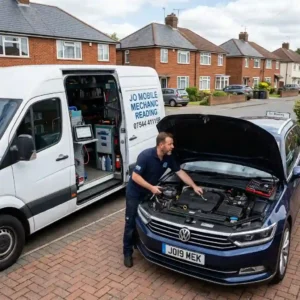
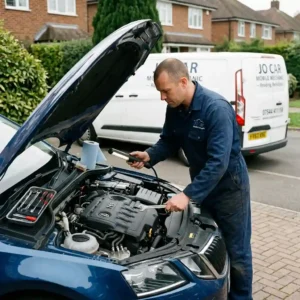
When your brakes begin showing signs of wear, driving across town to wait in a crowded garage waiting room can be inconvenient and unnecessary. Arranging a professional Mobile Brake Repair Reading appointment brings qualified technicians and high-specification brake inspection tools directly to your home driveway or workplace parking bay. Choosing a dedicated Mobile Brake Repair service ensures your stopping power is evaluated right where your car is parked. Discover how our mobile engineers deliver safe, reliable brake care by visiting JO Mobile Mechanic.
5 Common Warning Signs of Brake Problems
Brake components rarely fail without giving advance warning. Paying attention to changes in sound, physical feel, and dashboard alerts helps you identify potential issues early before booking a Mobile Brake Repair Reading visit.
1. Squealing or Grinding Noises
- Squealing Sounds: Most modern brake pads feature metallic wear indicator tabs designed to emit a high-pitched squeal when the friction material wears down to a critical level, indicating that a Mobile Brake Repair Reading check is due.
- Harsh Grinding Sounds: A loud, metallic grinding noise usually indicates that the brake pad friction material has completely worn away. The metal backing plate is now contacting the metal brake disc directly, requiring an urgent Brake Repair intervention to prevent further disc damage.
2. Steering Wheel or Pedal Vibrations
If you feel a pulsating or shaking sensation through your brake pedal or steering wheel while slowing down, it often points to uneven wear or thermal warping on your brake discs. When discs experience excessive heat cycles, their surface can become uneven, preventing the pads from making smooth, continuous contact and requiring expert brake repair Reading solutions.
3. A Soft, Spongy, or Sinking Brake Pedal
A firm, responsive brake pedal indicates a healthy hydraulic system. If your pedal feels unusually soft, spongy, or sinks all the way to the floorboard when pressed, air may have entered the hydraulic lines, or there could be a brake fluid leak within a caliper, wheel cylinder, or brake hose that a Mobile Brake Repair Reading specialist must inspect immediately.
4. Vehicle Pulling to One Side When Braking
If your car pulls or veers toward the left or right when you apply the brakes, the braking force is likely uneven across the front or rear axle. This symptom may indicate a seized brake caliper, a clogged hydraulic line, or unevenly worn friction pads on one side of the vehicle, which can be diagnosed during a Brake Repair visit.
5. Illuminated Brake System Warning Light
An active red or amber brake warning symbol on your dashboard should never be ignored. This light can indicate low brake fluid levels, an active Anti-lock Braking System (ABS) fault, or electronically detected pad wear limits that warrant an immediate Mobile Brake Repair Reading diagnostic scan.
Critical Road Safety: When to Stop Driving Immediately
While minor brake squeaks can be inspected at your earliest convenience, certain brake symptoms represent an immediate safety hazard that requires on-site Mobile Brake Repair Reading support.
CRITICAL ROAD SAFETY NOTICE:
If your brake pedal sinks to the floor, if your vehicle experiences a sudden loss of stopping power, or if a red brake system failure light illuminates while driving, do not continue driving to reach a distant workshop. According to official government guidance on National Highways Breakdown Safety, drivers experiencing critical safety faults should pull over safely off live carriageways, switch off the engine, and arrange qualified on-site assistance.
Continuing to drive with severely compromised brakes risks total hydraulic failure or extended stopping distances that can lead to collisions. Booking an on-site Mobile Brake Repair Reading visit allows an engineer to evaluate your vehicle where it is currently parked, eliminating the risk of driving an unsafe car across Berkshire.
What Does a Professional Mobile Brake Inspection Involve?
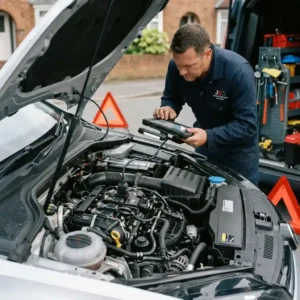
Choosing a mobile mechanic Reading specialist for your braking system does not mean compromising on inspection quality. A professional Mobile Brake Repair Reading service carries specialized hydraulic jacks, axle stands, electronic calipers, and digital diagnostic tools to carry out a comprehensive on-site check:
- Visual Pad & Disc Assessment: Measuring remaining friction material thickness on inner and outer pads and inspecting brake disc surfaces for lip formation, rust ridges, or scoring.
- Caliper & Hydraulic Lines Check: Inspecting rubber brake hoses for cracks, swelling, or fluid leaks, and verifying that caliper sliders move freely without binding during your Brake Repair Reading assessment.
- Brake Fluid Testing: Checking hydraulic fluid levels and testing moisture content to prevent vapor lock and internal corrosion.
- Digital Sensor Reset: Reading and clearing ABS or pad wear sensor codes using OBD-II computer diagnostic systems.
To learn more about our company standards, qualified mechanics, and local history, visit our About Us page.
The Advantage of On-Site Mobile Brake Repairs in Reading
Arranging your brake repair Reading service through a mobile provider offers distinct advantages over traditional garage visits:
| Performance Feature | Traditional Fixed Garage | Mobile Brake Repair Reading |
| Service Location | Fixed commercial workshop | Your home driveway or office car park |
| Travel Requirements | Requires driving, lifts, or expensive taxis | Zero travel required – your Mobile Brake Repair Reading specialist comes straight to you |
| Workday Impact | Hours lost dropping off and retrieving the vehicle | Carry on working or relaxing indoors while repairs happen |
| Transparency | Work takes place behind closed workshop doors | Direct access to inspect worn pads and discs with your Brake Repair mechanic |
| Safety Advantage | Risk driving a car with worn brakes across town | Car remains stationary while fresh parts are installed on-site |
Preparing Your Car for a Mobile Brake Repair Visit
To ensure your Mobile Brake Repair Reading appointment proceeds smoothly, following a few simple preparation steps is helpful:
- Firm & Level Ground: Park your car on a solid, flat surface such as asphalt, concrete, or block paving so hydraulic jacks and safety stands can be used securely during your Brake Repair service.
- Clear Side Access: Leave roughly 1 to 1.5 meters of space on both sides of the vehicle to give the technician room to remove wheels and position tool trolleys.
- Locking Wheel Nut Key: Place your locking wheel nut key on the driver’s seat or dashboard so the mechanic can remove your wheels without delay.
- Workplace Access: If your Mobile Brake Repair Reading visit is scheduled at an office car park, notify building security or site management in advance.
If you have specific driveway access questions, feel free to ask our team via our Contact Us page.
Mobile Brake Repair Reading: Frequently Asked Questions
How long does a mobile brake repair Reading service take?
Replacing front or rear brake pads typically takes between 45 to 60 minutes on-site. A full Mobile Brake Repair Reading session replacing both brake pads and brake discs on an axle usually takes roughly 1.5 to 2 hours.
Can a mobile mechanic replace brake discs and pads on my driveway in Reading?
Yes. A qualified Brake Repair technician carries heavy-duty hydraulic lifting equipment, axle stands, torque wrenches, and brake winding tools to replace pads and discs safely on flat driveways or parking bays.
Why are my new brakes squeaking after being fitted?
Minor squeaking during the first 50 to 100 miles can occur while new brake friction material beds into the disc surface. However, persistent loud squealing should be checked by your mobile mechanic Reading specialist to ensure anti-squeal shims and mounting points are properly lubricated.
Will my car fail its MOT test if the brake warning light is on?
Yes. Under UK MOT guidelines, any active illuminated brake system or ABS warning light results in an automatic MOT test failure. All underlying faults causing a Mobile Brake Repair Reading alert must be diagnosed, repaired, and reset prior to the test.
How do I know if I need new brake discs or just new pads?
Brake pads wear down faster than discs. If your brake discs meet minimum manufacturer thickness guidelines and show no severe warping, scoring, or heavy rust lip, replacing just the pads may be sufficient. Your Mobile Brake Repai Reading engineer will measure disc thickness and give you honest advice on-site.
Conclusion: Book Your Mobile Brake Inspection Today
Ignoring changes in braking performance compromises your safety and can turn simple pad replacements into expensive disc and caliper overhauls. Whether you are hearing faint squealing, experiencing pedal vibrations, or dealing with an active warning light, scheduling a prompt Brake Repair inspection ensures your car stops safely and predictably.
By choosing a dedicated mobile mechanic Reading specialist for your Brake Repair needs, you enjoy dealer-quality brake care without sacrificing your day or driving an unsafe vehicle across town.
Ready to restore complete stopping confidence to your vehicle? Explore our full service range on our Services page, read about our team on our About Us page.
To confirm service availability, check suitability for your vehicle model, and arrange a convenient Mobile Brake Repair Reading inspection, contact the expert team at JO Mobile Mechanic today via our Contact Us page. Let us keep you safe on the road!