You are driving along the A33 or navigating morning traffic near Reading Station when a sudden chime sounds and a brightly lit symbol appears on your instrument cluster. Your immediate reaction is usually a mixture of confusion and stress. What does that symbol actually mean? Can you safely complete your journey to work, or are you risking catastrophic mechanical damage by continuing to drive?
When dealing with unexpected dashboard symbols, guessing is a dangerous game. Instead of ignoring the symbol or searching for generic answers online, local drivers need a structured decision-making process: Recognize the Warning ➔ Assess the Urgency ➔ Understand Potential Causes ➔ Take Safe Action.
Whether you are parked at home, stranded at your workplace, or pulled over on the side of the road, addressing Car Warning Lights Reading issues early prevents small sensor glitches from turning into thousands of pounds in repairs. Discover how our qualified mobile diagnostic specialists carry out comprehensive fault checks on your driveway by visiting JO Mobile Mechanic.
Step 1: Recognize the Warning (Symbol & Colour Coding)
Your car’s dashboard uses a standardized, color-coded traffic light hierarchy designed to tell you how quickly you must act. The moment a new light illuminates during your drive, look closely at its shape and color:
- Red Warning Symbols (Immediate Action Required): Indicates a critical safety issue or an active engine failure. Red symbols mean you must address the Car Warning Lights Reading issue straight away.
- Amber / Yellow Warning Symbols (Advisory & Fault Stored): Indicates that an engine, emissions, or braking sub-system has detected an operational fault. While the car may still drive normally, scheduling a Car Warning Lights Reading diagnostic check promptly is essential.
- Green / Blue / White Symbols (Informational Only): Indicates that a vehicle feature is active, such as your main beam headlights or cruise control.
Understanding how color coding works helps you make calm, informed decisions when tackling Car Warning Lights Reading scenarios. You can review our full range of breakdown diagnostic solutions on our Services page.
Step 2: Assess Urgency — Is It Safe to Keep Driving?
The most important decision you make when a dashboard symbol appears is whether to pull over or continue driving carefully.
CRITICAL ROAD SAFETY NOTICE:
If your vehicle exhibits a flashing engine management light, a red oil pressure warning, an engine temperature/overheating warning, or a red brake system failure light, you must act immediately. According to official government advice on National Highways Dashboard Warning Lights, drivers should pull over safely off the live carriageway, switch off the ignition, and consult their vehicle handbook rather than continuing to drive simply to reach a garage.
When You MUST Stop Driving Immediately:
- Flashing Engine Management Light: Indicates an active engine misfire that can rapidly melt your catalytic converter and cause severe internal cylinder damage.
- Red Oil Can Symbol: Signals a severe drop in engine oil pressure. Running an engine without oil pressure will cause total engine seizure within minutes.
- Red Temperature Gauge / Coolant Light: Means your engine is actively overheating. Continuing to drive risks warped cylinder heads and blown head gaskets.
- Red Brake Warning Light: Indicates critically low brake fluid levels or a complete hydraulic pressure failure.
If you are currently parked with a red warning light illuminated on your driveway or at work, do not risk driving across Berkshire. Contact our team directly via our Contact Us page to request a mobile Car Warning Lights inspection.
Step 3: Understand Possible Causes (Why One Light Can Mean Multiple Faults)
A common mistake drivers make when facing Car Warning Lights Reading issues is assuming that a specific symbol points to one single broken part. Modern vehicles use networked Electronic Control Units (ECUs) that monitor hundreds of parameters. A single warning light simply acts as a broad flag for a whole category of potential issues.
Amber Check Engine Light (Engine Management)
A steady amber check engine light means the ECU has logged a fault code relating to engine performance or exhaust emissions. Resolving this Car Warning Lights Reading trigger usually requires reading digital sensor logs.
- Possible Causes: Faulty lambda/oxygen sensors, mass air flow (MAF) meter failure, failing ignition coils, split vacuum hoses, stuck EGR valves, or even a loose fuel cap.
ABS & Traction Control Warning Lights
When the Anti-lock Braking System (ABS) light illuminates, your standard mechanical brakes will still stop the car, but emergency anti-skid protection is disabled until a Car Warning Lights in Reading scan is performed.
- Possible Causes: A cracked ABS wheel speed sensor ring, a failed wheel speed sensor, damaged wiring harnesses, or low battery voltage disrupting ECU initialization.
Battery / Charging System Warning Light
A red battery symbol does not simply mean you need a new battery; it indicates that the car’s electrical charging system is failing, which is one of the most common urgent Car Warning Lights complaints.
- Possible Causes: A snapping auxiliary drive belt, a worn alternator diode, corroded battery terminals, or an aging battery unable to store charge.
To read more about how our certified mechanics evaluate complex electrical and mechanical faults across Berkshire, head over to our About Us page.
Step 4: Choose the Next Step — Why a Diagnostic Scan Is Essential
When an amber or red symbol appears, guessing which part to replace leads to wasted money on unnecessary components. Modern vehicles require a digital OBD-II scan to resolve Car Warning Lights queries accurately by reading the exact Diagnostic Trouble Codes (DTCs) stored deep within the car’s memory modules.
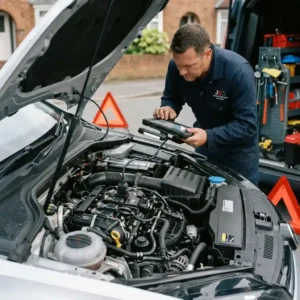
- 1. Digital OBD-II Scan: The technician plugs advanced diagnostic hardware into the vehicle’s OBD port to extract precise manufacturer fault codes stored in engine, ABS, or airbag modules.
- 2. Live Data Analysis: The engineer evaluates live engine telemetry such as fuel trim, sensor voltages, and operating temperatures to verify why your Car Warning Lights Reading fault was triggered.
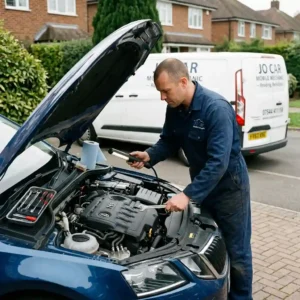
- 3. Physical Verification: The technician physically inspects wiring looms, vacuum pipes, drive belts, and fluid levels on-site to prevent replacing expensive electronic parts when a split hose or corroded wire is to blame.
- 4. Fault Reset & System Testing: The mechanic clears stored codes and performs live cycle tests to ensure the Car Warning Lights Reading symbol stays off and the underlying fault is fully resolved.
You can check out our full capabilities for on-site computerized fault finding on our Services page.
Step 5: How JO Mobile Mechanic Resolves Warning Light Issues in Reading
When a warning symbol forces you to stop driving or leaves you worried on your driveway, getting your car towed to a static garage adds unnecessary delay, stress, and cost.
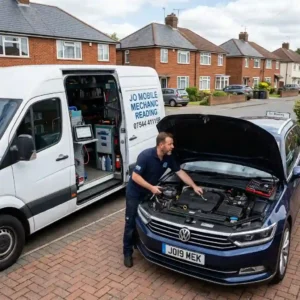
Choosing a dedicated Car Warning Lights Reading specialist from JO Mobile Mechanic brings full dealer-level diagnostic capabilities directly to your location. Whether your vehicle is parked outside your home in Tilehurst, at your workplace in Green Park, or on a driveway in Earley, our mobile service vans travel straight to you to resolve any Car Warning Lights in Reading emergency.
- On-Site Mobile Diagnostic Workflow: Book a mobile visit ➔ Technician arrives on-site ➔ OBD-II computer scan ➔ Clear fault explanation ➔ On-site component repair.
We carry portable multi-system diagnostic computers, digital battery testers, and specialized hand tools to diagnose and repair your Car Warning Lights Reading issues on the spot—saving you recovery fees and keeping your workday intact.
If an unexpected light has appeared on your dashboard, do not wait for the problem to escalate into an expensive breakdown. Learn more about our company standards on our About Us page, review our comprehensive diagnostic options on our Services page, or book your on-site Car Warning Lights Reading inspection today via our Contact Us page. Trust the experts at JO Mobile Mechanic to keep your vehicle safe, reliable, and error-free.
Car Warning Lights Reading: Frequently Asked Questions
Can I drive my car with an amber check engine light on in Reading?
If the amber light is steady and your car is driving normally without shaking, power loss, or strange noises, you can usually drive a short distance safely. However, you should arrange a professional Car Warning Lights diagnostic scan as soon as possible to prevent long-term damage.
What should I do if my engine management light starts flashing?
A flashing engine management light signals a severe, active engine misfire that can cause catastrophic catalytic converter failure. Stop driving as soon as it is safe to pull over, switch off your engine, and book an immediate on-site Car Warning Lights Reading inspection through JO Mobile Mechanic.
Will a dashboard warning light cause my car to fail its MOT test?
Yes. Under UK MOT guidelines, any illuminated main warning light (such as ABS, airbag, engine management, or brake warning symbols) at the time of testing results in an automatic MOT failure. All stored fault codes linked to Car Warning Lights Reading triggers must be diagnosed, repaired, and reset prior to your test.
Why did my warning light stay on after I changed the faulty part?
Vehicle ECUs store historical fault codes in their non-volatile memory. Even after a faulty component is replaced, the Car Warning Lights Reading symbol often remains lit until a technician connects an OBD-II diagnostic tool to clear the stored fault codes and reset the module.
Can a mobile mechanic diagnose complex warning lights on my driveway?
Yes, mobile technicians carry portable, high-specification diagnostic computers capable of reading ECU data, resetting fault codes, and resolving Car Warning Lights Reading problems directly on your driveway or office car park.